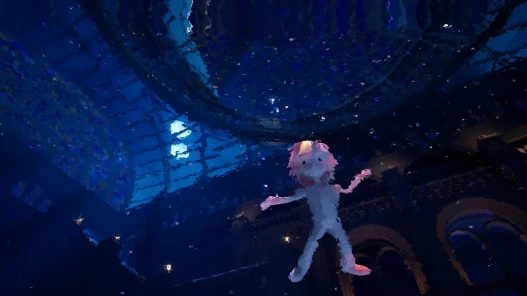
You awaken on a fog-shrouded shoreline and meet Echo, a strange child with a hole in their stomach. Together you cross a lantern festival where the veil between worlds is thinnest, sail into an ocean that opens beneath you, and descend through a portal into the Underworld.
The Underworld moves through different facets of grief: a rave where silhouettes dance in slow motion, indifferent to Echo's attempts to reach them; a frozen sea where giant statues crack open to release a buried memory of a lost mother; a shadow theatre where an anger monster is unleashed, reducing everything to embers.
From the embers, a boat carries you into a vast darkness, where Mother appears, and they are finally reunited. You sail together to the Tree of Life, a bioluminescent, cosmic jungle. Echo begs her to return to the World of the Living, but ancestors appear and surround you. She cannot come back - the journey was never about bringing her back. Echo, revealed to be your own child self, dissolves around you as the hole fills with light.
How do we remember the past when our history has been faked?
One man’s idea to rebuild a capital on the foundations of an unfinished city erased a collective memory, casting a dark shadow over Skopje's future identity.
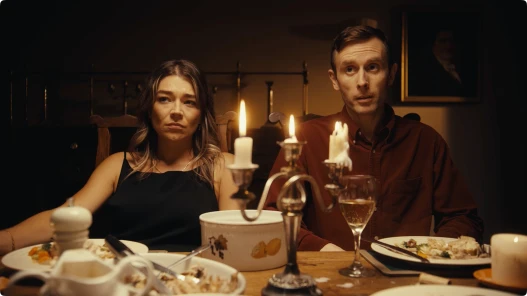
Lily and her husband Charlie, a couple in their early thirties, quietly fall apart inside a rural farmhouse inherited from Charlie’s father. Lily, an agoraphobic artist haunted by a childhood coma that left her temporarily paralysed, secretly performs ritualised asphyxiation to feel control over her body. Charlie, unable to face his hidden sexuality, seeks anonymous encounters with strangers. Their private compulsions hold their marriage together in a fragile, unspoken equilibrium. This balance fractures when Sam and Hannah arrive next door. Sam, a severe, cult-like presence, and Hannah, his unsettlingly youthful companion, first appear as eccentric but intriguing neighbours. Yet their charm soon curdles. They slip into Lily and Charlie’s routines, testing boundaries, dissolving privacy, and infiltrating their emotional space. A psychological game of mimicry deepens into ritualistic horror as Lily and Charlie’s identities begin to erode. Sam and Hannah exploit the psychological fault lines of their victims, using hidden fears and repressed desires as points of entry. As the distinctions between self and other blur, Lily must confront her deepest fear: losing control of her own body. Sam and Hannah are not simply neighbours - they are fallen angels on the run from the wrath of God.
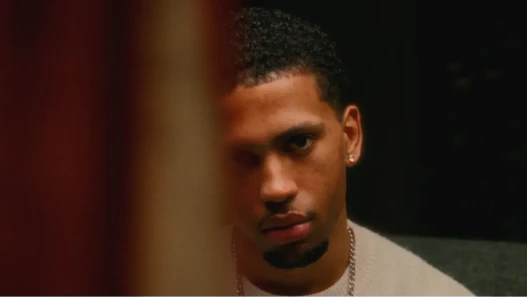
When five teenage boys go viral after a rap performance, a humiliating moment is filmed and shared online, unleashing the unforgiving judgment of the internet.
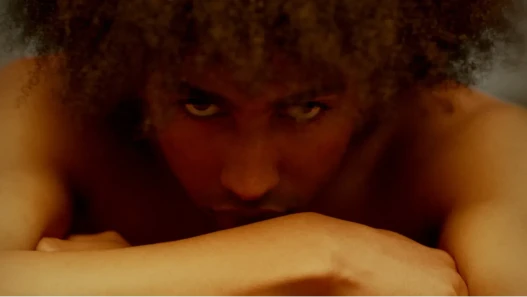
A group of teenage boys become entangled in a series of escalating "games" built around a single rule: don’t flinch.
What begins as playful competition gradually shifts into something more controlled, more psychological, and more dangerous. As the boundaries blur, each boy is forced to navigate power, performance, and the pressure to appear unbreakable.
FAIR explores how identity is shaped under pressure, and what it takes to hold your ground in a world where showing weakness isn’t an option.
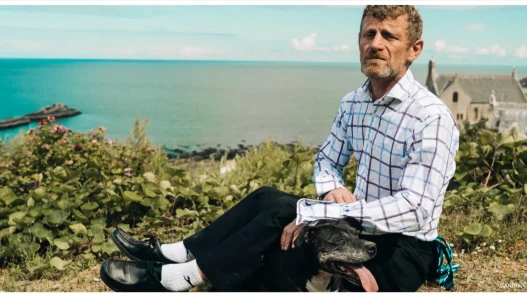
An intimate documentary that captures the daily ongoings in the historical fishing village of Gardenstown. At the heart lie Juliet and Bubbles and their eclectic extended family and friends. This film will document their resilience, joy, and profound connection to community in a lyrical exploration of human experiences.
Hello You is an autopsy of your reflection. This mirror has two sides: one that observes, and another that follows. Exploring stories of altered perception, from phantom limbs to the feeling of being a stranger in your own body, the experience stretches the split-second act of self-recognition into something you can watch unfold. Here you are asked not to look at yourself, but at the lenses through which you look.
Lost Souls, Swimming in a Fish Bowl is a silent documentary about the invisible territories of depression, isolation, memory, and the fragile act of continuing to live.
There are people who move through the world every day while feeling as though they exist behind glass. They work, walk, eat, sleep, smile, and disappear into crowds—yet remain suspended within an interior world that no one else can enter. The film observes these fractured states without explanation, diagnosis, or spoken testimony.
Instead, silence becomes the language of the film.
Through faces, bodies, empty rooms, urban landscapes, found footage, archival fragments, photographs, gestures, objects, and moments of stillness, Lost Souls, Swimming in a Fish Bowl enters the psychological geography of people who feel trapped inside themselves. The fish bowl becomes both metaphor and physical space: transparent enough to see the world outside, yet impossible to escape.
Adlais (Echo) weaves Welsh language folklore and histories through their shared subjects of poetry and drowning – and asks whether we’re listening to the past as it surfaces today.
In the summer of 1997, two 19 year old lovers set out from the Birmingham suburbs in a classic car. Their destination: the grave of Nick Drake, whose music had become a shared language between them and a comfort for their unacknowledged pain.
This journey, captured in memory and reimagined on screen, becomes a meditation on youth,
longing, and the quiet power of music to shape identity and connection where deeply hidden
vulnerabilities can be shared.
Interwoven with this personal narrative are intimate audio interviews with artists from different
generations who reflect on how Drake’s music shaped their lives and creative paths. Their
insights echo and deepen the emotional terrain of the road trip, creating a layered portrait of
influence, absence, and resonance.
What if you went on a holiday and the apocalypse happened?
GALICIA! is a found-footage, hybrid-documentary following a couple through home video footage as they visit their friends at a winery in rural Spain and inadvertently capture the end of days.
We live in a time where the sense of our impending mutually assured destruction is more real than it’s ever been. GALICIA! Takes the form of a holiday video - a document of a couple before - and after the great cataclysm. The film starts as something that feels unedited - an accidental video diary of an ordinary couple that feels somewhat ghostly as much as it is also pedestrian. As the film evolves and degrades, we are led to question the fragility of humanity, as well as its power to endure.
A woman attempts to address the self that has shaped her life until now - the “Me” formed through trauma, habit, and survival.
Conceived in relation to the cinema of Ingmar Bergman and Michael Haneke, the film locates meaning in the actor’s presence and in the organisation of cinematic form, rather than in dialogue or narrative guidance.
This encounter is not a dialogue but a struggle: the effort to speak to a governing inner presence in order to loosen its hold. As the film unfolds, the confrontation moves deeper, toward a dark, underground interior where escape seems impossible. In the final movement, a rupture appears - a hole, a glimpse of sky, hands reaching upward from below. Whether she gets out remains uncertain. What matters is that the exit has been found.