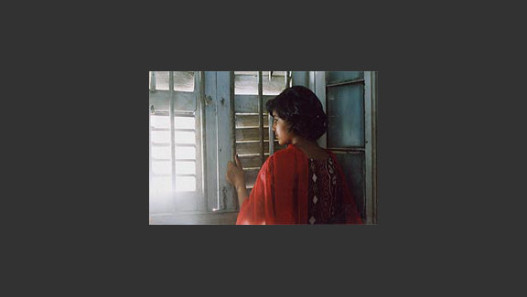
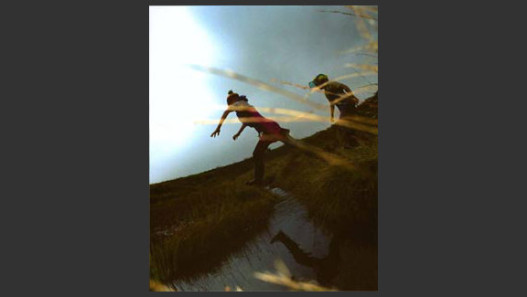
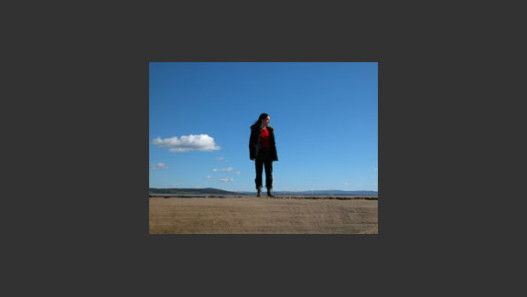
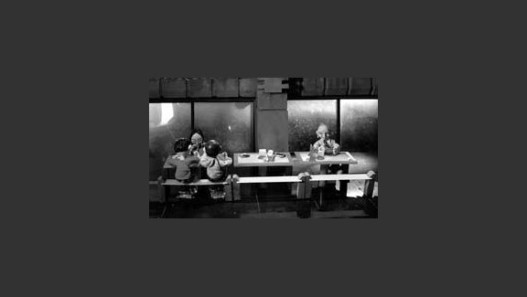
London 1961. Alex, a jazz musician, and Faith, a singer, share an uneasy life together. The relationship 'on the rocks' Faith is willing to try to win back Alex by any means. Alas her attempts at making Alex jealous by leaving the club with a stranger backfire. Assuming that Faith has found a new beau Alex leaves their flat not knowing that Faith has been waiting for him.
I Could Read the Sky a film about music, madness memory, love and loss, a haunting story of immigration.
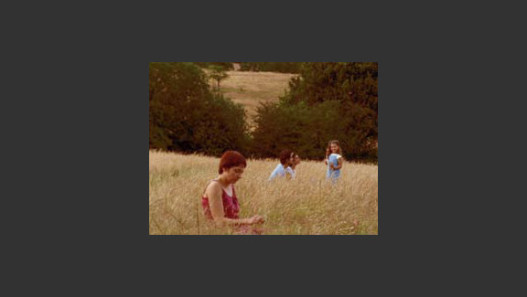
I Could Read the Sky is adapted from the photographic novel of the same name which has been recently published to rave reviews and explores the sense of identity, loss and exile. It is the moving story of an old man living in a bedsit in London, remembering his life, growing up on the West coast of Ireland and his journey to London.
The film unravels the strange twisting drama of a working man's life. It moves from a decaying rural past to a vividly modern present, driven by a dynamic music soundtrack that draws from both, and a simple flowing lyrical story telling. It is the state of memory that the film evokes, not memory as re-enactment but as texture. The film gets to the essence of how we remember. Memory as fragments, as details and layers, memory that comes at you out of the dark. From behind closed eyes, with its abstractions of light and form and sudden moments of precise clarity, taking us on an inward, visually extraordinary labyrinthine journey to the film's end.
The film stars the acclaimed Irish writer Dermot Healy and includes cameos from actors Maria Doyle Kennedy, Brendan Coyle and Stephen Rea, writer Pat McCabe (Butcher Boy) and the author Timothy O'Grady and photographer Steve Pyke.
When Mr and Mrs Peach's neighbours emigrate to Australia, they leave the grieving Peaches anxiously twitching the net curtains of their suburban home wondering who will arrive next door. The new neighbours, Mr and Mrs Chapman, prove to be far from the ideal couple the Peaches had dreamed of. They are loud, rude and aggressive.
Mr Peach takes an instant dislike to the 'flash' Chapmans aggravated by the fact that, as a desperately bad salesman, he is getting deeper and deeper into debt. Mr Peach is struggling to hold onto his job, his house and his mind and as the bills mount up and the creditors move in he begins to slip further and further into his own interior world, obsessing about the new neighbours and increasingly perceiving them as the enemy. It is not long before he is spying on their every move, making complaints against them, even damaging their property. The Chapmans, outraged at his 'interfering, busy-body' behaviour, begin to retaliate, until both sets of neighbours are caught up in an intensifying feud. Their problems escalate out of all proportion and when Mr Chapman dares to stamp on Mr Peach's prize winning pansies a fight breaks out in the garden and Chapman beats up Peach. Mr Peach finally deems his neighbours responsible for all his problems and in one final conflict, decides to make them pay.
Nasty Neighbours is a thrilling black comedy. It puts England under the spotlight and exposes cracks in the veneer of cul-de-sac life. Funny, sad and fiercely original it is the debut feature film of Debbie Isitt.
With it's compelling tale of romantic tragedy in nineteenth century Russia, Alexander Pushkin's epic novel 'Eugene Onegin', has moved and intrigued audiences for 150 years.
Captivated by its powerful narrative about love and loss, award winning actor Ralph Fiennes (The English Patient, Schindler's List) and his sister, director Martha Fiennes, have assembled a talented and exciting team to bring Pushkin's story to the screen.
Evgeny Onegin is a jaded and disaffected young man who leaves St Petersburg unexpectedly when he inherits an estate from a wealthy uncle. In the country, he is a city sophisticate out of place, with little affinity for the countryside or its people. Nevertheless he strikes up a warm friendship with a neighbour, Vladimir Lensky and, despite his natural cynicism, he is charmed by Lensky's love for his fiancée Olga. He is also intrigued by Olga's sister, Tatyana, a spirited beauty who surprises him with a passionate declaration of love. Onegin is disturbed by her directness but unable to respond and, coolly and politely, rejects her love.
As if needing to demonstrate the cruelty of his nature, Onegin later insults Olga and is challenged to a duel by Lensky who's code of honour prevails when Onegin attempts to extricate both of them from the confrontation. Onegin's shot is fatal and, grief-stricken, he cradles his best friend's body in his arms. Afterwards he leaves and goes into self-imposed exile.
Six years later, Onegin returns to St Petersburg where he again encounters Tatyana, now married to his cousin Prince Nikitin. In realisation of the bitter mistake he made years ago, Onegin determines to claim her and Tatyana is faced with the most difficult decision of her life.
The Alcohol Years is Carol Morley's personal odyssey of rediscovery through the people that once populated her alcohol fueled life in Manchester between 1982 and 1987. These years span the opening of the Hacienda night club to the 'tenth summer', a ten year anniversary of punk.
Confined by his work to a small studio apartment, we follow the progress of The Artist as he tries to follow his dreams in New York City. Working on a large drawing from start to finish, he talks of influences and past work. Stephen's understated sense of humour simmers throughout.
The Greatest Store in the World is a gripping, entertaining, poignant Christmas special for all the family. Who needs a toy when you can have the whole toy department? Why watch one television when you can watch hundreds? Who needs to write to Santa Claus when he's right there in his Grotto? A cold, homeless, present-less, cracker-less Christmas is transformed into every child's fantasy when a mother takes her two children to live in the greatest store in the world. But what starts as a spirited search for refuge, becomes a nail-biting adventure, as 'away in a manger' turns into a race against time, crime and a wicked Santa Claus and his malicious elfin side-kick
This is a short film about love at first sight. It happens in the time when love transforms the world from physical to metaphysical; when people, things and places become different. Wildlife combines dramatic action with dance on a journey into dream territory, mixing Celtic mythology, Shanghai pop and modern mysticism.
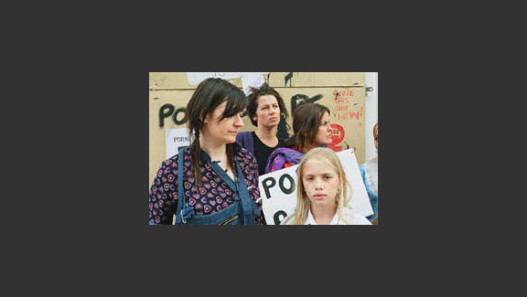
A Bunny Girl's Tale is a short documentary investigating the British story of the Playboy Bunny and how 'The Bunny Girl' still persists in the collective imagination.
All for Eight Pounds Fifty is a light comedy set in Northern Ireland. The Heroes or villains of the piece decide that robbing a small country petrol station will give them enough money to have a good time.
The robbery is a success but the haul is not quite what they expected.
Follows six adults and five children - we learn how, not only sneezing, eye irritation, eczema and urticaria but digestive problems (IBS) migraine, joint pain, behavioural difficulties, fatigue and even severe depression have all been caused by an allergy or intolerance.
Anthrakitis tells the story of Dolly, an elderly widow, who has been hoarding coal since the deaths of her husband and son years ago in mining accidents. When Dolly realises that everyone in the village wants a bit of her fifty foot high coal mountain, including her home help, Winny, Dolly is forced to take drastic measures . . .