
The Futora
Synopsis
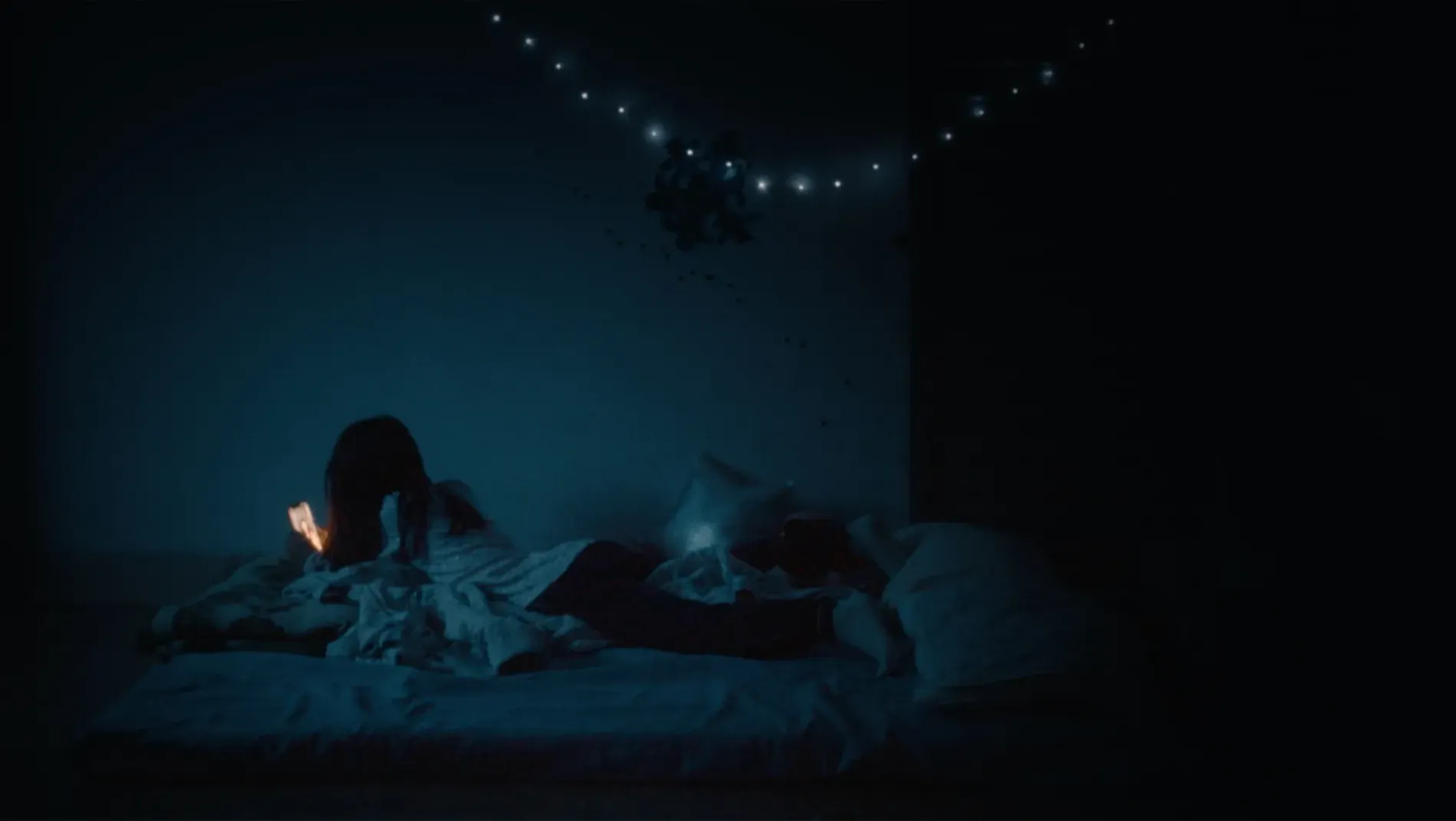
Inspired by 1980s and 1990s Chinese children's science fiction films like WONDER BOY, the filmmaker reimagines electricity not just as infrastructure, but as a living force - speculating: what if the ghost that once inhabited lightbulbs and circuits is now displaced, scattered across phone screens and the devices of a sleepless global supply chain?
In this film, the ghost transforms from a figure of mystical empowerment into a fragmented existence, diffracted, dispersed, and re-coded.
Assembling fragmented connections through material and time from light accessory factories in southern China, through the dreams and imagination of children living nearby, and the port town of Grays in eastern England. These peripheral spaces appear to host accidental encounters, yet in reality, they serve as vital nodes in the circulation of low-cost global goods - concealing the shadow infrastructures of globalisation.
Official Selection CPH:DOX 2026
Details
- Year
- 2025
- Type of project
- Shorts
- Running time
- 13 min 5 sec
- Format
- Digital
- Director
-
Yuqing Lin
- Producer
- Yuqing Lin
- Executive Producer
- Yuqing Lin
- Editor
- Yuqing Lin
- Sound
- Yew Brown
- Principal cast
- Ximo Fan, Yifei Hu
- Production Assistant
- Ailiao Zhang
Genre
Production Status
Page updates
This page was last updated on 2nd March 2026. Please let us know if we need to make any amendments or request edit access by clicking below.
See also
You may also be interested in other relevant projects in the database.
 This Case
Director: Kemi-Bo Miller Jacobs
Year: 2026
Mary, a young mixed-race librarian, becomes convinced that a neighbour’s St George’s Cross is connected to her growing anxiety and disrupted sleep. As her unease intensifies, she struggles to distinguish reality from perception and must find the courage to speak up before she begins to unravel.
 Anak Where Did We Stay?
Director: Sadia Pineda Hameed
Year: 2026
ANAK WHERE DID WE STAY? is a five-channel film by Sadia Pineda Hameed that brings together The Box’s home movie collection and the artist’s personal/family collection. Rasheed Araeen’s chakras, spouting waves, Beatlesmania, a basking shark, hula dance, an Enoch Powell protest, tidal islands and seafoam floating into the air—the archives converge across time to tell the story of the artist’s mother’s migration from one archipelago to another: the Philippines to the British Isles. The film becomes a gathering site for personal and collective experiences of journeys, resilience and belonging. Road trips unexpectedly reenact the archive, footage finds itself out of context, voices commentate the film as if rewatching a home movie together; mimesis, associations and autonomy are central to the retelling. As camcorders became more accessible from the 1970s onwards, home movies were an unconscious means to rebuild personal archives after colonial displacement, extraction and erasure. ANAK WHERE DID WE STAY?, named after the home movie from The Box’s archive 'Perranporth Where Did We Stay?', unfolds as a conversation between the artist and her mother, exploring the three interconnected journeys of migration, holidays and remembering. Produced as part of The Box’s Reimagining the Film Archive programme (BFI Screen Heritage Fund).
 Moving Sound
Director: Sadia Pineda Hameed
Year: 2025
MOVING SOUND is a speculative work set across 1980s and near-future Wales, shot on super 16mm. In the film, sounds of present day anti-colonial and anti-capitalist strategies for mining strikes are transmitted from Soundcamp streamboxes to the past via an underground, time travelling broadcast. In the 1980s, workers build DIY receivers from Moving Sound portable audio devices, which they use to distribute the broadcast around sites of production and the everyday. First screened in the King Coal Experience (an immersive recreation of the Big Pit underground mine) amidst disused mining machinery, MOVING SOUND blurs fictional 16mm and archival 8mm footage of sonic action to explore how organising converges and enacts across geographies, temporality, fantasy and reality.