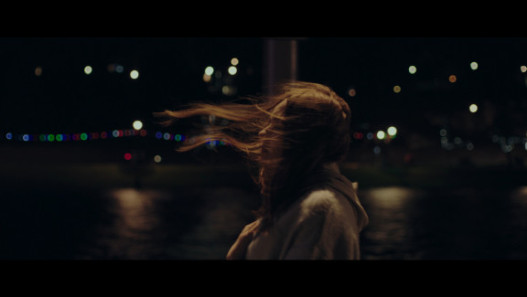
In the Highlands of Scotland, a girl suffers the suicide of her best friend. In a town renowned for it’s growing suicide rate, she spirals into a mid-twenties crisis.
Witty and sarcastic, her manner is rapid and quick fire. If only someone could hear her hilarity. She can’t seem to connect with anyone and her awareness of mortality consumes her.
She forms relationships with various men in attempts to find herself again. She meets a man simultaneously enduring a mid-life crisis and she develops an anonymous connection with an old man over the phone who is at the end of his own life.
None of them give her the answers she needs and ultimately, she is left to confront herself, and what's truly haunting her.
Written and directed by Karen Gillan, this surreal coming of age tale is her love letter to her hometown.
“How can you be criminalised for being born the way you are?” asks George Montague, a 96 year old WWII veteran, beginning this documentary. His words echo through the film.
“ARE YOU PROUD?” meets key campaigners and investigates the organisations and events that have contributed to substantial progress within the western LGBTQ+ liberation movement, focussing on the history of Pride in the UK. It celebrates that progress, whilst exploring the controversial questions over the continuing relevance of the Pride march, and highlights the international battles still to be fought.
Combining archive footage, interviews, vox pops and reportage, the film guides us through the history of the Gay Pride movement in the UK. We meet founders of the Gay Liberation Front, founding members of Stonewall (The UK’s leading LGBTQ+ lobbying organisation), the organisers of various Pride marches across the UK, groups such as Black Pride, Trans Pride Brighton and Queer Picnic. The film celebrates the progress that has been made, we are also reminded of “the fact that there are an increasing number of people out there who feel emboldened in hating queers.”
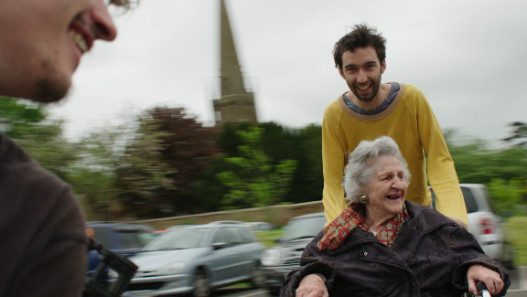
How does memory work? How can experiences be handed down from generation to generation? How does the act of narration change the experience? Three young men and their grannies go on a quest for their historic and personal legacy. There’s the British spy with a bone-dry sense of humour, the Hungarian communist who survived the Holocaust and the German dancer whose look back turns out to be the most difficult.
Unlike many recent documentaries which focused on conversation and raised their protagonists on a pedestal of awe, the “Granny Project” takes a different approach: playful, not afraid of confrontations, sometimes silly and seconds later honest and emotional. An unconventional attempt of the grandchildren’s generation to ask, on a different level, questions that drove their parents to the streets in the 1960s. This film neither aims to be antagonistic nor accusatory. Instead it’s perhaps naive but no less necessary attempt to understand the other. When the three grannies sit around a table with their grandsons and various interpreters we realise that two things at least are necessary to really bring the past and present in contact: an honest interest in one’s opposite party and a good translation. (Dok Leipzig brochure 2017)
Official Selection Dok Leipzig 2017 - World premiere
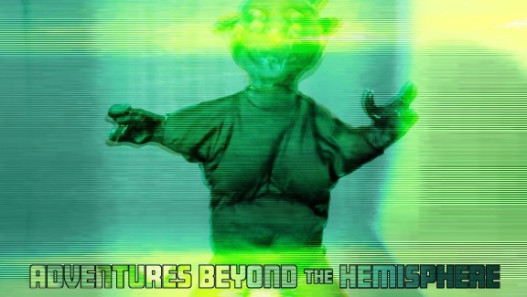
A journey by train somewhere in Britain throughout the thoughts of various passengers in 21st century post-Brexit delving on the history of Britain.
There is a train of thought floating around between each passenger during the journey. The train journey is interrupted several times when the train has stopped, and the voice of the train driver is heard through the speakers. During the long and often agonizing and irritating sets of announcements by the train driver the passengers are forced to endure the agony of hearing his voice and what he is saying.
The protagonists are taking the shape of puppets and humans and they represent the diverse population of the United Kingdom.
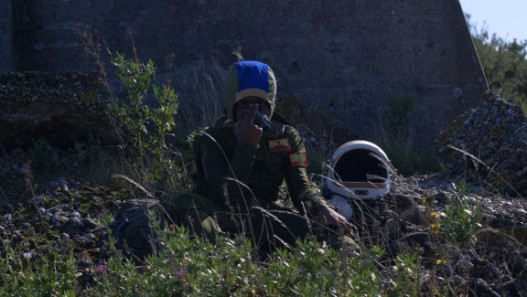
'Relic 1' forms part of Larry Achiampong's Relic Traveller: Phase 1, a multi-disciplinary project manifesting in performance, audio, moving image and prose.
Taking place across various landscapes and locations, the project builds upon a postcolonial perspective informed by technology, agency and the body, and narratives of migration.
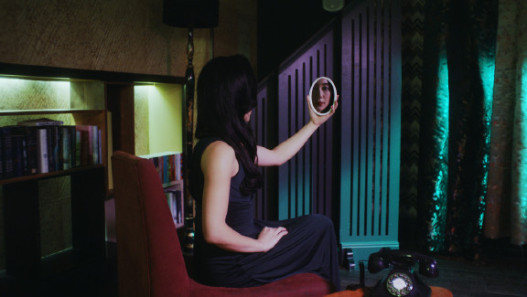
An experimental narrative film that paints a portrait of Japanese performance artist Ayumi Lanoire.
The film opens as a telephone call between the subject and Person X, which meanders and leads the audience through the various layers that make up her persona leading one to question whether she is, in fact, a myth or reality.
A woman with mild agoraphobia lives her life in a high rise apartment as she experiences various moments of environmental aggression, trauma and psychosis.
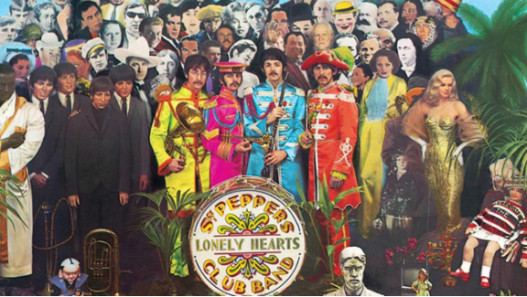
As The Beatles end their gruelling tour schedule in August 1966 they return to the studio to record the landmark ‘Sgt. Pepper’ album.
As one of the biggest selling records of all time, described by Rolling Stone magazine simply as “The most important rock & roll album ever made…”, ‘Sgt Pepper’ (released in June 1967) marked a pivotal moment in the 1960s, cementing the advent of Psychedelia and the Summer of Love.
This documentary journies through various solo projects to the release of Strawberry Fields Forever/Penny Lane, touching on flower power, John Lennon meeting Yoko Ono, LSD, meditation, Jimi Hendrix, the death of Brian Epstein, Abbey Road Studios and the Magical Mystery Tour.
Among the interviewees featured in the film are Hunter Davies (the band’s official biographer), Pete Best (the band’s original drummer), music manager Simon Napier-Bell and author Philip Norman, who has written biographies of The Beatles and The Rolling Stones and of Paul McCartney among others.
Based on the true story of the 2015 Hatton Garden jewel heist.
A group of older career criminals who were variously nicknamed the "diamond geezers", "bad grandpas” and the “Enfield Expendables” were recruited by an ex-con to carry out what appeared to be a 'perfect' crime. During a long weekend in April, the group tunneled into a London vault and carried away millions of pounds worth of jewellery, gold and other goods.
Mad To Be Normal reveals the story of R.D. Laing, a psychiatrist known as one of Scotland's greatest thinkers. Working out of Kingsley Hall - situated in East London throughout the 1960s and 1970s, Laing performed various daring experiments on people who were at the time known as disturbed.
His methods included using LSD and a type of self-healing, known as metanoia, much to the dismay and outrage of the psychiatric community.
A meditative, immersive tribute to the astonishing work and achievements of naturalist, inventor and pioneering filmmaker F. Percy Smith. Smith worked in the early years of the 20th century, developing various cinematographic and micro-photographic techniques to capture nature's secrets in action. Working in a number of public roles, including the Royal Navy and British Instructional Films, Smith was prolific and driven, often directing several films simultaneously, apparently on a mission to explore and capture nature's hidden terrains.
This film is an interpretative edit that combines Smith's original footage with a new contemporary score by tindersticks to create a hypnotic, alien yet familiar dreamscape that connects us to the sense of wonder Smith must have felt as he peered through his own lenses and seen these micro-worlds for the first time. (LFF brochure)
Official Selection BFI London Film Festival 2016 - Sonic Strand - World premiere