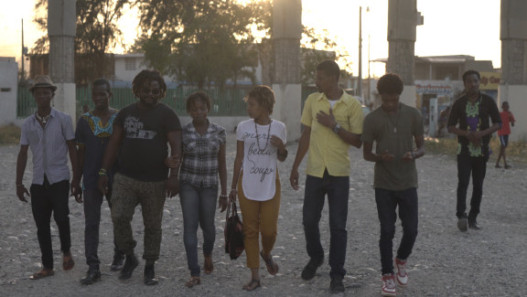
A snapshot of an edgeland, Tilbury in Essex, during the months leading to the Brexit deadline in March 2019. The film moves back and forth between the individual, human-scale portraits of migration and the representation of the town’s economic activity.
A double portrait of two women whose lives have been shaped by a shared passion for homemaking and hospitality. Over the course of the film we see Rosemary and Nancy in their cottage in Yorkshire, where they have settled in retirement. We hear them speak about the project they embarked on together, which saw them shelter and re-house over five hundred families in Massachusetts over a thirty year period, as well as providing a personal and historical context to their story.
WHAT DOES WATER TASTE LIKE? questions the production of identity as it relates to the filmmaker's personal affiliations as a British-Nigerian. Prompted by intimate conversations, the film conjoins footage and voices of the past with their counterparts in the present-tense.
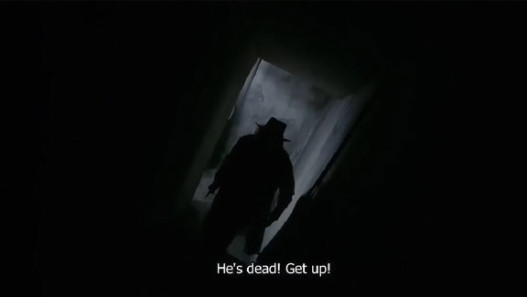
A young male patient of a psychiatric hospital, witnesses the death of another Black male patient at the hands of white staff. Blurring the boundaries between fact and fiction, this work draws from real life cases of Black mentally ill men who have died as a result of excessive force.
Using a visual rich balance of documentary and animation KINGS OF SUMAVA poetically explores the duality of hero, villain and reunites former Czech immigrant Vlasta Bukovsky and Czech people smuggler Josep Hasil. The infamous boarder guard who lead those who needed to leave communist Czechoslovakia through the mountains of Sumava and to freedom. Due to the communist regimes failed attempts to catch Josef his family were imprisoned for over 180 years.
A short film about the Argentine electroacoustic composer Beatriz Ferreyra, an original pioneer of early musique concrète alongside Pierre Schaeffer during the ‘50s and ‘60s. Here she discusses her ‘sound hunting’ recording techniques, and other thoughts on sound montage and spatialization. Featuring creaking doors, barking dogs and rainbow hands.
Official Selection International Film Festival Rotterdam (IFFR) 2020
Welcome to the age of cosmic radiation! THE PHANTOM MENACE compiles stories from the recent past of interaction with cosmic rays at ever descending altitudes. Planes crashing, computers malfunctioning and elections going haywire - these were just the prequel to the future.
Official Selection Berlin International Film Festival 2020 - Forum Expanded - World premiere
a ROLE to PLAY brings together the lived experiences and dreams of Bolsover residents, one of the most deprived towns in the middle of England. The film tells stories of the impact of economic changes in a post-industrial Derbyshire constituency where coal was once king.
An inquiry into proximity and empathy, explored through the working life of a care worker as he builds supportive relationships with three young adults with severe physical disabilities and autism.
A man in a room, in a film – it is the becoming of something and simultaneously becoming in itself. Nothing is as solid as we believe.
The film explores our perception of time, bodies and objects, and our inability to comprehend the full motion of things.
An atmospheric journey into the heart of modern England, filmmaker Louis Price weaves together scenes of everyday life within the Black Country in the West Midlands. An area once so industrialised the sky appeared black during the day, and red during the night, today the Black Country is a place of ghosts, existing in the aftermath of its industrial past. Black Country - A Film From England takes place entirely in one day, observing crematoriums, night clubs, UKIP pubs, living rooms and Council Chambers with a hallucinatory eye that presents no easy answers, or neat narrative resolves.
Mixing a combination of industrial archive footage, experimental sound design (wax cylinder recordings, player piano, distorted 78 RPM records), with stripped back austere camera compositions and mysterious, mundane and sometimes unsettling subjects, Black Country is a distorted postcard from a confused and increasingly indecipherable England.
As a sci-fi obsessed woman living in near isolation, Beverly Glenn-Copeland wrote and self-released Keyboard Fantasies in Huntsville, Ontario back in 1986. Recorded in an Atari-powered home-studio, the cassette featured seven tracks of a curious folk-electronica hybrid, a sound realised far before its time.
Three decades on, the musician – now Glenn Copeland – began to receive emails from people across the world, thanking him for the music they’d recently discovered. Courtesy of a rare-record collector in Japan, a reissue of Keyboard Fantasies and subsequent plays by Four Tet, Caribou and more, the music had finally found its audience two generations down the line.
'Keyboard Fantasies: The Beverly Glenn-Copeland Story' tells the time-travelling tale of this mystical musician and vocalist, as the present finally catches up with him and he embarks on his first international tour at the age of 74.
Capturing five decades of relentless musical output and shifting manifestations of gender and sexual identity, set against a backdrop of profound social change, the film celebrates the unpredictable rhythms of life.
A lullaby to soothe those souls struggling to find their place in the world.